L · LEADERSHIP
“I can’t take a holiday without the business calling me.”
If everything still runs through you, the business depends on one person. Here is how founder succession planning helps founders in Trinidad and Tobago and across the Caribbean step back without the business falling apart.
Confidential. Nothing is shared with other family members without your permission.
Does this sound like your family?
You built it, and you are still the one who knows where everything is, who everyone calls and how every decision gets made. You would like to step back, or at least take a proper break, but nobody seems ready.
Meanwhile, the next generation is waiting for a chance to lead, or has quietly stopped waiting.
You might also be saying:
- “Nobody’s ready to take over from me.”
- “My children want to come in, but I’m not sure they can run it.”
- “I don’t know what I would do if I stopped.”
What it’s costing you
- The business is only as strong as your health and your availability.
- Successors never get the chance to learn by leading.
- Key knowledge, relationships and passwords live in one head.
- The longer it waits, the harder the handover becomes.
What would help
- Learn to leave: map what only you know and do, and hand it over step by step.
- Learn to lead: give the next leader real responsibility, with support, before the handover.
- A succession plan with dates, agreed by the family, so it actually happens.
- Plan your own next chapter, so stepping back feels like a beginning, not a loss.
What families say
As a founder, I had a vision of building a multigenerational legacy. Ria helped me understand what I needed to do for this to become a reality.
First-generation business owner
Questions about founder succession planning
When should a founder start succession planning?
Well before you need to. A handover usually takes years, not months, because the next leader needs time to learn by leading.
What if none of my children want to take over?
It is more common than families admit, and it is not a failure. The options include a non-family manager, a board, or a planned sale. What matters is that the decision is made deliberately, not by default.
What happens to my role after I step back?
That is part of the plan. Many founders move into a chair, board or mentoring role. Deciding what you are stepping towards makes it far easier to let go.
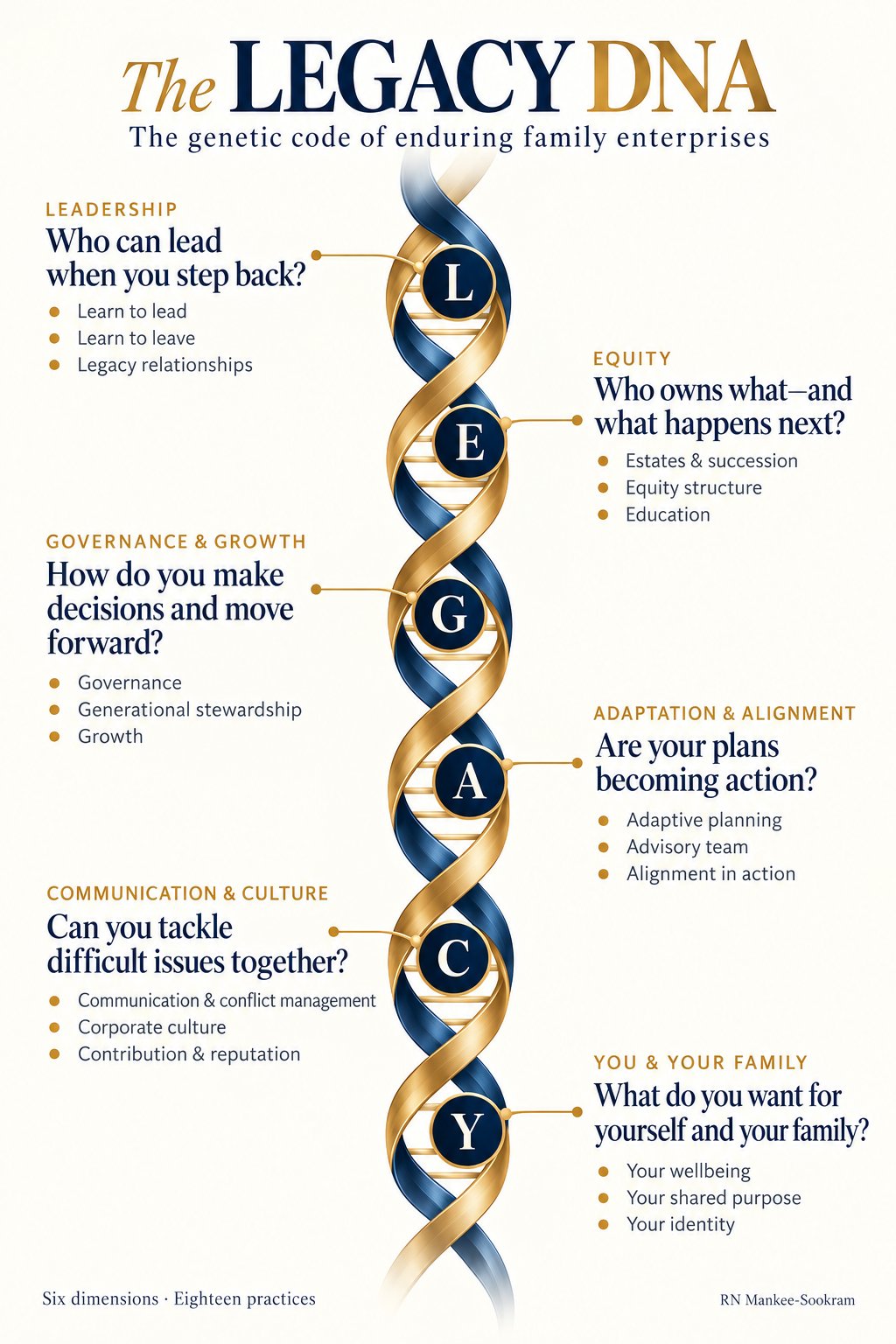
Where this fits in the LEGACY DNA
Founder succession planning sits under L · Leadership in the LEGACY DNA: who can lead when you step back? The free Legacy DNA check shows where your family business stands on it, alongside the other five dimensions.
I cover this in more depth in my book, The Seven Domains of the Family Business.
What happens next
- Take the free Legacy DNA check. About 10 minutes, with an instant read on where your family business stands.
- Have a confidential conversation. We talk through what’s really going on. You’ll know the fee before any paid work begins.
- Get your plan. The full Legacy DNA Diagnostic, then the documents and structures it points to.
Confidential. Nothing is shared with other family members without your permission.