
G · GOVERNANCE & GROWTH
“Everyone has a say, but nothing gets decided.”
When nobody is sure who decides what, every decision becomes a family debate. Family business governance doesn’t mean bureaucracy. It means knowing how decisions get made, so the business can move forward.
Confidential. Nothing is shared with other family members without your permission.
Does this sound like your family?
Every choice, from hiring a manager to opening a second location, turns into a family discussion. Some people want to grow, others want to protect what you have, and nobody is sure who has the final say.
Or the opposite happens: one person decides everything, and everyone else stops speaking up.
You might also be saying:
- “We can’t agree on whether to expand.”
- “Family members who don’t work in the business still want a vote.”
- “We don’t know the difference between a board meeting and a family meeting.”
What it’s costing you
- Good opportunities pass while the family debates.
- Managers, family and non-family, can’t act without approval.
- Growth stalls, or happens without a plan.
- Frustration builds on both sides: those who run the business and those who own it.
What would help
- Separate the three roles. Family, owners and managers each have their own forum and their own decisions.
- Write down who decides what, and what needs a vote, so it isn’t renegotiated every time.
- Bring in outside perspective through an advisory board or independent director when the family is too close to the question.
- Agree a direction for growth, so decisions are measured against a plan the family has signed up to.
What families say
Our father did not leave a Will and there were many issues both in the family and in the business that arose as a result. Through communication, governance and succession strategies, our family was able to come to an amicable mutual agreement.
Second-generation family business
Questions about family business governance
What is family business governance?
The agreed way a family business makes decisions: who decides what, how the family, the owners and the managers each have a say, and what happens when they disagree.
Isn’t governance only for large companies?
No. A smaller family business needs it just as much, in a simpler form. Even a short family charter and a regular family meeting can change how decisions get made.
Do family members who don’t work in the business get a say?
As owners, usually yes, on ownership questions. Day-to-day management is a different matter. Good governance makes that line clear.
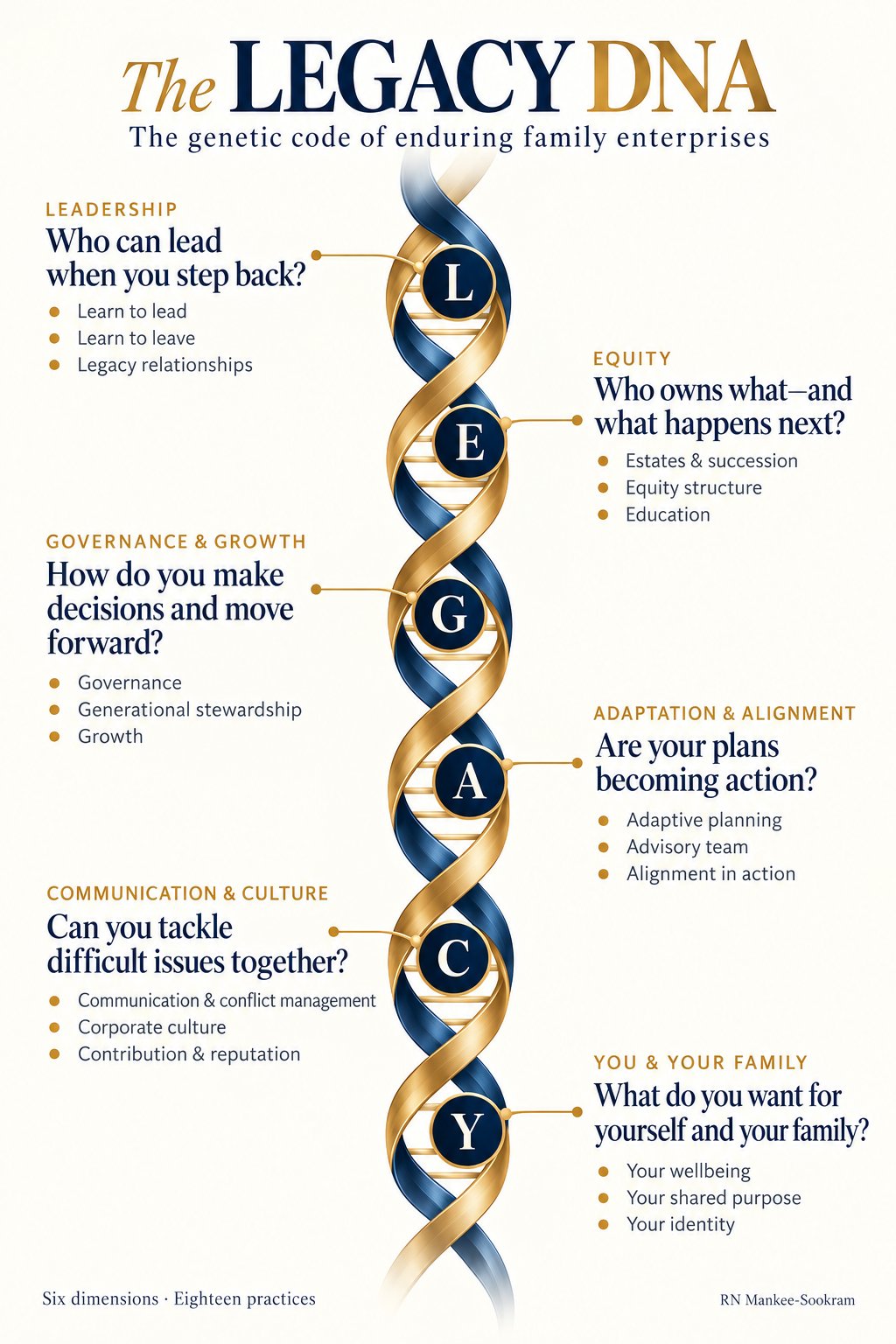
Where this fits in the LEGACY DNA
Family business governance sits under G · Governance & Growth in the LEGACY DNA: how do you make decisions and move forward? The free Legacy DNA check shows where your family business stands on it, alongside the other five dimensions.
I cover this in more depth in my book, The Seven Domains of the Family Business.
What happens next
- Take the free Legacy DNA check. About 10 minutes, with an instant read on where your family business stands.
- Have a confidential conversation. We talk through what’s really going on. You’ll know the fee before any paid work begins.
- Get your plan. The full Legacy DNA Diagnostic, then the documents and structures it points to.
Confidential. Nothing is shared with other family members without your permission.