
C · COMMUNICATION & CULTURE
“We keep having the same argument.”
When the same disagreement comes back every week, the problem is rarely the topic. It is how the family talks, decides and repairs. As a mediator, this is where I start with family business conflict.
Confidential. Nothing is shared with other family members without your permission.
Does this sound like your family?
It might be about money, a new idea for the business, or who should be making decisions. The details change; the argument doesn’t. Family meetings end in silence or shouting, and people stop raising things altogether.
Many families only look for help once relationships are already strained. Getting help earlier makes the conversation easier.
You might also be saying:
- “Family meetings end in silence or shouting.”
- “We avoid talking about the business at family events.”
- “My brother and I only speak through our parents.”
What it’s costing you
- Decisions stall while the family argues.
- Good people, family and staff alike, pull back or leave.
- Resentments build until a small issue becomes a legal dispute.
- The next generation decides the business is not worth the trouble.
What would help
- A neutral person in the room. As a mediator, I help families say what needs to be said and actually hear each other.
- Family meetings with agreed rules: who attends, how decisions are made, and what happens when you disagree.
- A way to raise hard issues early, before they turn into a crisis.
- Mediation when it has already broken down, as an alternative to going to court.
What families say
Our father did not leave a Will and there were many issues both in the family and in the business that arose as a result. Through communication, governance and succession strategies, our family was able to come to an amicable mutual agreement.
Second-generation family business
Questions about family business conflict
What is family business mediation?
A confidential, structured conversation led by a neutral mediator. The family, not a judge, decides the outcome. It is usually faster, less costly and far less damaging to relationships than going to court.
When should we bring in a mediator?
Earlier than most families do. If the same argument keeps coming back, or people have stopped raising an issue at all, that is the time.
Can the business keep running while we sort this out?
Yes. Part of the work is agreeing how day-to-day decisions will be made in the meantime, so the business doesn’t stall while the bigger questions are resolved.
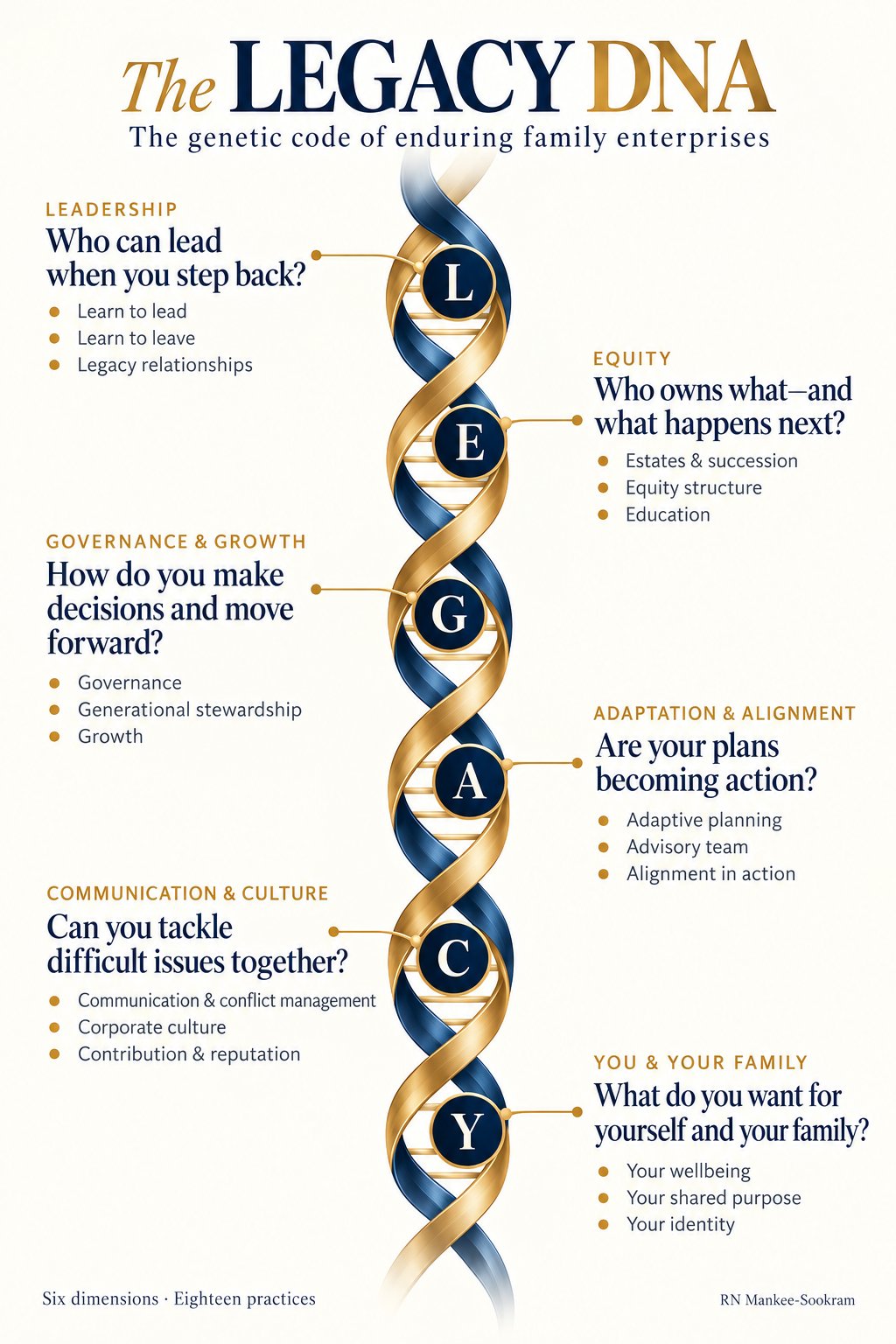
Where this fits in the LEGACY DNA
Family business conflict sits under C · Communication & Culture in the LEGACY DNA: can you tackle difficult issues together? The free Legacy DNA check shows where your family business stands on it, alongside the other five dimensions.
I cover this in more depth in my book, The Seven Domains of the Family Business.
What happens next
- Take the free Legacy DNA check. About 10 minutes, with an instant read on where your family business stands.
- Have a confidential conversation. We talk through what’s really going on. You’ll know the fee before any paid work begins.
- Get your plan. The full Legacy DNA Diagnostic, then the documents and structures it points to.
Confidential. Nothing is shared with other family members without your permission.